

Cycle of open seminars
Open access at Campus UAB
Edifici MRA, 1a planta
Bellaterra
Registration for open seminars
Form to confirm attendance in advance
(to assess whether the capacity requires reserving the room at the Metròpoli Institute – MRA Building, floor 2)
UPCOMING SEMINARS
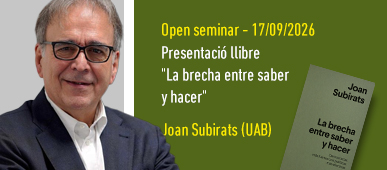
Date: 17/09/2026 sala reunions Institut Metròpoli
Speaker: Joan Subirats (UAB)
Book presentation: “La brecha entre saber y hacer”.
FORTHCOMING
 Date: 01/10/2026 a les 12:30h sala reunions Institut Metròpoli
Speaker: Jorge Rodríguez Menés (UPF)
Title: “Trajectories of IPV offenders” (TBC).
Discussant: Margarita León (UAB).

Date: 15/10/2026 a les 12:30h sala reunions Institut Metròpoli
Speaker: Marta Vallvé (UPF)
Title: “The Materiality of Socio-Ecological Conflicts: A Revised Interpretation of Marx’s Theory of Metabolic Rift”.
Discussant: David Palomera.

Date: 29/10/2026 a les 12:30h sala reunions Institut Metròpoli
Speaker: Zhijia Tian (Nankai University)
Title: “Closing Cases without Resolving Disputes: Administrative Translation, Temporal Compression, and Preserved Discretion in Standardized Dispute Handling in Grassroots China.”
Discussant: Margarita León (UAB).
 Date: 19/11/2026 a les 12:30h sala reunions Institut Metròpoli
Speaker: Roberta Perna (CCHS – CSIC)
Title: “Between Policy Homelessness and Institutional Anchors: The Divergent Trajectories of Long-Term Care Reform in Italy and Spain after the Pandemic Shock”
Discussant: Ixchel Pérez (UAB).
SEMINARS HELD

Date: 25/06/2026 a les 10:30h sala reunions Institut Metròpoli
Speakers: Àlex Boso i Cristian Oltra (CIEMAT)
Title: “Heatwave adaptation beyond vulnerability: protective intentions, public cooling and thermal security in urban Spain”.
Discussant: Carlos Delclós (UAB).
Abstract:
As extreme heat becomes a recurrent feature of urban life, adaptation policies lean on two expectations: that residents will take protective action when heatwaves strike, and that public cooling infrastructures will shelter those who need them. Drawing on the VULNERA project, this seminar puts both expectations to the test through two connected empirical studies. The first examines what shapes people’s intention to protect themselves during future heatwaves, drawing on an online survey of 1,508 adults in Barcelona, Valencia and Zaragoza. Hierarchical regression models weigh the explanatory power of objective vulnerability against risk perception, self-efficacy, perceived response efficacy and perceived environmental conditions. Objective vulnerability turns out to matter little; what predicts protective intention is the perceived effectiveness of protective measures, together with concern, self-efficacy, social norms and the perceived quality of official information. The second study turns to Barcelona’s climate-shelter network and asks whether formal provision actually translates into thermal protection. Combining thermal-stress modelling, GIS-based accessibility analysis, survey data and ethnographic fieldwork, it finds that proximity and facility counts say little about whether people are protected. Effective use rests on a longer conversion chain: shelters have to be recognisable, open when they are needed, materially cool and socially habitable. The two studies suggest that heat adaptation reduces neither to individual vulnerability nor to the provision of infrastructure. Protective capacity arises instead from the interplay of beliefs, perceived efficacy, social support, trustworthy information and the everyday conditions that let people convert available resources into lived thermal security.
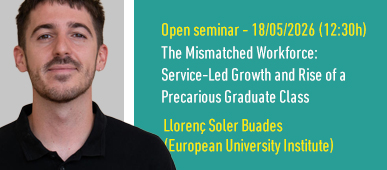
Date: 18/05/2026 a les 12:30h sala reunions MRA
Speaker: Llorenç Soler Buades (European University Institute)
Title: “The Mismatched Workforce: Service-Led Growth and Rise of a Precarious Graduate Class”.
Discussant: Jorge Rodriguez Menés (UPF).
Abstract:
This project examines the growing disjuncture between educational expansion and labour market outcomes in advanced European economies. While higher education systems have expanded under the assumption that they would support the transition to knowledge-based economies, many countries have struggled to generate sufficient high-quality, skill-matched employment for graduates. The study conceptualises this issue as a “mismatched workforce” and distinguishes between two forms: occupational mismatch, where graduates are employed in jobs below their level or field of qualification, and job-quality mismatch, where employment fails to provide adequate stability, security, or earnings.
The (preliminary) core argument is that these mismatches cannot be reduced to individual characteristics or the mere expansion of education. Rather, they emerge from the interaction between sectoral growth patterns and labour market institutions. Economies characterised by low-end service-led growth and higher levels of labour market deregulation are more likely to generate both occupational mismatch and precarious forms of graduate employment. By contrast, coordinated systems with stronger collective bargaining institutions, a greater presence of knowledge-intensive sectors, and/or higher public-sector absorption tend to align graduate skills more effectively with labour market demand and provide better-quality employment outcomes.
Bringing together insights from comparative political economy and the sociology of work, the project aims to analyse cross-national variation in labour market mismatches across Europe. Preliminary evidence from the European Social Survey points to substantial cross-country differences in both types of mismatch, with younger cohorts disproportionately affected, underscoring the structural challenges facing contemporary graduate labour markets.
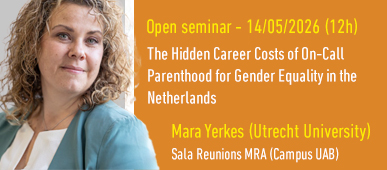
Date: 14/05/2026 a les 12h sala reunions MRA
Speaker: Mara Yerkes (Utrecht University)
Title: “The Hidden Career Costs of On-Call Parenthood for Gender Equality in the Netherlands”.
Discussant: Adriana Offredi (UAB).
Abstract:
Nobel-prize winning economist Claudia Goldin has argued that being the “on-call parent” (that is, being the parent primarily responsible for emergencies, like picking up a sick child from school or daycare), is a key barrier to gender equality in men and women’s careers. In this seminar, Prof. Mara Yerkes will present findings from the study On Call, Off Track? The Hidden Career Costs of On-Call Parenthood that examines this issue in the Netherlands. Drawing on a unique survey on on-call parenthood combined with register data, the study aims to provide insights that can address persistent gender differences in Dutch society and the labor market. During the seminar, preliminary results will be presented on how caregiving responsibilities influence parents’ career paths in the Netherlands and what this means for gender inequality.
Bio
Mara A. Yerkes is Professor of Comparative Social Policy in relation to Social Inequalities at the Department of Interdisciplinary Social Science, Utrecht University, the Netherlands. Her research centres on comparative social policy (including national and local welfare state policy and industrial relations), social inequalities (related to work, care, communities and families, in particular relating to gender, generations, and sexual orientation) and their interplays.

Date: 30/04/2026 a les 12:30h sala reunions MRA
Speaker: Adrian Bua (IGOP-UAB)
Title: “Trajectories of Change, Co-optation and (De)Democratization: towards a Bourdieusian Field Theory of Participatory Democracy”.
Discussant: Yanina Welp (Albert Hirshman Centre on Democracy).
Abstract:
This article uses Bourdieu’s field theory to examine the evolution of political participation in Europe and the West since the second half of the twentieth century, to the emergence of a subfield of institutionalized participation, often called “democratic innovation.” Although these processes originate in radical politics, they have been deradicalized as they have been institutionalized. So what remains of their democratic potential? Through a reconstruction of the history of political participation in the social democratic and neoliberal eras, I show that, as new practices expand, co-optative pressures increase. I argue that the social structure exerts a field force that intensifies as participatory practices move closer to the “field of power,” with a generally deradicalizing effect. However, the field of political participation retains possibilities for change through ongoing field struggles over field-specific symbolic capital, and the development of new practices in “local fields.” Furthermore, co-optation does not necessarily mean a symbolic gesture. Rather, the institutions that co-opt must make changes in form to make the co-optation effective. Thus, in non-revolutionary moments, change occurs through a circuit that consists of co-optation and renewal of practices. Finally, the concept of participatory capital is developed to explain how the field of participation evolves in the struggles between actors who defend different participatory ethics. I conclude that, although the greater structural power of capital in neoliberalism limits the field of participation to a greater extent than in social democracy, this remains a space in conflict, where possibilities for democratization persist.
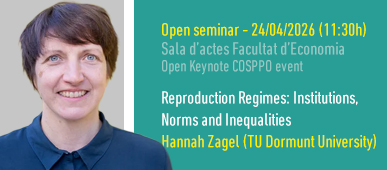
Date: 24/04/2026 a les 11:30h sala d’actes (Facultat d’economia)
Speaker: Hannah Zagel (TU Dormund University)
Title: “Reproduction Regimes: Institutions, Norms and Inequalities“.
Open Keynote part of the 3rd Early Career Workshop on Comparative Social and Public Policy (COSPPO).
Abstract:
Varieties of reproduction regimes: institutions, norms and inequalities
Reproduction policy as a regulatory field of the welfare state has received little scholarly attention so far. But state measures that directly intervene in processes of having or not having children, such as abortion, contraception or medically assisted reproduction, fulfill central welfare state functions: They address social risks and inequalities and can either guarantee or limit social rights, also reproducing ideas of who deserves to reproduce. This study proposes a theoretical and empirical typology of ‘reproduction regimes’ of developed welfare states, considering different fields of regulation of reproduction in terms of what is being addressed and how. The concept of social reproductive risks is employed to describe welfare states’ attention to potentially negative individual and collective consequences of reproductive processes; and institutional variation is considered in terms of permissiveness and cost compensation. Four theoretical regime types are identified: a universalist, an interventionist, a liberal and a selective type. Empirically, quantitative policy indicators for 30 countries from the new International Reproduction Policy Database (IRPD) are used to operationalize the policy level. The analysis expands welfare state research with a systematic, empirical perspective on reproduction policy.
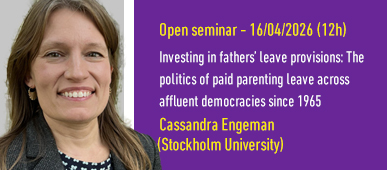
Date: 16/04/2026 a les 12h sala reunions MRA
Speaker: Cassandra Engeman (Swedish Institute for Social Research)
Title: “Investing in fathers’ leave provisions: The politics of paid parenting leave across affluent democracies since 1965″.
Discussant: Dani Marinova (IGOP-UAB).
Abstract:
Encouraging fathers to take parenting leave has been the subject of policy directives from the European Commission and the aim of recent innovations in family policies across several countries. Yet, expansions have been uneven historically and cross-nationally. Using pooled time-series cross-sectional analysis, this paper examines relationships between different political actors and leave provisions, namely, paternity and parental leave duration, pay, and allocation as individual, non-transferable entitlements. Analysis combines independently developed fathers’ leave provision indicators and data from publicly available comparative political data sets. Overall, results support power resources explanations for family policy expansion, though women lawmakers regardless of partisanship also play a facilitative role. Results also suggest a complicated role for confessional right parties. Such parties have a positive effect on fathers’ total leave provisions but a negative effect on the duration of fathers’ well-paid leave, which poses more of a challenge to traditional gender norms.
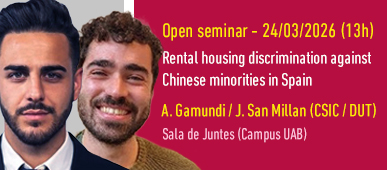
Date: 24/03/2026 a les 13h sala de Juntes Facultat CCPP
Speakers: Javier San Millán i Antonio Gamundi (Delft University of Technology / CSIC)
Title: “Rental housing discrimination against Chinese minorities in Spain: a new instant messaging correspondence test”.
Discussant: Dani Marinova (IGOP-UAB).
Joint Seminar DEC/IGOP
Abstract:
Research on rental housing discrimination (RHD) against migrant minorities has overwhelm ingly focused on the first generation, paying special attention to the most sizeable immigrant groups. As a result, we still know little about the housing-market experiences of immigrants’ children and the less sizeable—but often fast-growing—ethnic minorities. RHD research has also lagged behind the spectacular growth of online apps for conducting private rental transactions. We present a novel instant messaging correspondence test to study (real) private landlords’ responses to (fictitious) f lat seekers of native and Chinese background in Madrid, Spain. Drawing on instant messaging allows us to introduce innovative treatments for phenotype and cultural assimilation. We find moderate levels of RHD against visibly Chinese-background applicants with a fully Chinese name and who use full Chinese characters in their WhatsApp status profile (low assimilation condition) but very low levels of discrimination against visibly identical applicants who combine a Spanish first name with a Chinese last name (typical of the second generation) and who use the word “Madrid” in Latin alphabet in their app status profile (high assimilation condition). Finally, we find adding signals of f lat-seekers’ income reliability (diagnostic treatment) does not reduce discrimination propensity. Results are robust to stringent controls for ethnic composition and COVID-19 incidence rate at the district level. These findings highlight the primacy of perceived cultural assimilation over racial appearance and information deficits in shaping RHD against Chinese minorities in Spain and illustrate the analytical pay-offs of using instant messaging correspondence tests in discrimination research.

Date: 17/03/2026 a les 12h Sala de Juntes
Speaker: Mateo Mandelli (Sciences Po CNRS, Paris)
Title: “Europe in the midst of a green backlash: the comparative and multilevel politics of sustainable agriculture policies”.
Discussant: Óscar Molina (UAB).
Joint Seminar QUIT/IGOP
Abstract:
After gaining unprecedented momentum towards the end of the 2010s, the European path towards environmental sustainability is now facing a growing polarization and contestation, which has prompted several analysts to speak about a green backlash. A striking manifestation of this phenomenon occurred between 2023 and 2024, when farmers across the European Union (EU) mobilized in mass protests against the European Green Deal and specifically its provisions for greening agriculture. In the scholarly literature, the green backlash remains empirically underexplored, especially when it comes to unpacking its impact on policymaking. This seminar seeks to advance our knowledge on this matter by comparatively investigating the multilevel politics of sustainable agriculture policies in Europe. The presentation advances three core contributions. First, it offers a review of existing studies on the green backlash, identifying key trends and gaps, particularly from a public policy perspective. Second, the seminar focuses on the EU level, tracing the trajectory of the most recent Common Agricultural Policy reform – from its initial framing as a cornerstone of the Green Deal to its substantial scaling back after farmers’ protests – and compares it with EU energy decarbonization policies, which have instead proven slightly more resilient. Third, the analysis shifts to the national level, comparing policy responses to farmers’ protests in four Western European countries – France, Germany, Ireland, and the Netherlands – which differ in the extent of concessions granted to farmers and the rollback of sustainable agriculture measures. Preliminary findings suggest that the design of green policies and the way governance structures balance competing interests are key to prevent backlash from eroding the political stability of Europe’s climate action.
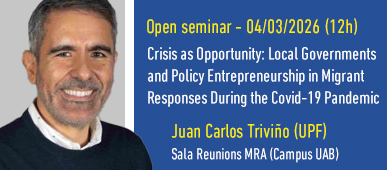
Date: 04/03/2026 a les 12h sala reunions MRA
Speaker: Juan Carlos Triviño (Transdem / IGOP)
Title: “Crisis as Opportunity: Local Governments and Policy Entrepreneurship in Migrant Responses During the Covid-19 Pandemic”.
Discussant: Eva Ostergaard (UAB).
Joint Seminar TransDem/IGOP
Abstract:
In today’s interconnected world, transboundary crises, such as the Covid-19 pandemic, are becoming increasingly common, exposing vulnerabilities that affect global societies. The pandemic had a particularly severe impact on migrants living in cities, especially those in vulnerable situations derived from the legal-administrative status (e.g., undocumented individuals, rejected asylum seekers, or those awaiting administrative decisions) and socio-economic conditions (e.g., migrants experiencing homelessness, temporary agricultural workers, and those employed in the service sector). This study examines the extent to which local governments act as policy entrepreneurs to protect these vulnerable populations during crises, as well as the reasons for their varying levels of engagement. Theoretically, our paper explores the relationship between crisis management and policy entrepreneurship at the local level, with a focus on vulnerable populations such as migrants. Empirically, we apply this theoretical framework to qualitatively analyse the responses of four mid-sized Spanish municipalities that at their own initiative offered a repertoire of policy actions addressing these individuals – namely, Almería, Getxo, Fuenlabrada and Lleida – during the Covid-19 pandemic. We argue that these initiatives reflect a form of entrepreneurial governance, where crises serve as policy windows for innovation and pragmatic problem-solving. Rather than ad hoc responses, these actions represent a shift from routine policymaking to a crisis-time logic centered on complementarity, coordination, and responsiveness. Local governments, acting as innovation brokers, mobilized networks and resources to fill institutional gaps and mitigate exclusion. Our contribution aims to enhance the understanding of the capacity and willingness of local public administrations to promote and channel entrepreneurial governance arrangements that engage with vulnerable groups’ needs.
Date: 05/02/2026 a les 13h sala reunions MRA
Speaker: Jordi Honey (ICTA, BiciZen)
Title: “Superblock Barcelona: Streets for Urban Experimentation“.
Discussant: Lorenzo Vidal (IGOP-UAB).
Abstract:
In urban planning circles, Barcelona is well known for its implementation of Superblocks: a traffic management and urban design strategy that prioritizes street space for people over motor vehicles. Barcelona captured global attention when the mayor and team committed to scaling the Superblock strategy to the entire city. Could Barcelona become the first car-light city in Europe? Since then, the strategy has evolved considerably, leading us to ask how Barcelona´s Superblocks strategy has been implemented in practice. How has Barcelona´s Superblock strategy evolved from neighborhood units to green axes? What are the results thus far and how are Superblocks inspiring other cities? This presentation reviews the implementation and evolution of Barcelona’s Superblock strategy, from its origins to the present.
Date: 15/01/2026 a les 12h sala reunions MRA
Speaker: Yanina Welp (Albert Hirshman Centre on Democracy)
Title: “Why Populism ‘Wins’? The Limits of Mini-Publics in Addressing Power and Legitimacy”.
Discussant: Adrian Bua (IGOP-UAB).
Abstract:
Democratic innovations emerged as a response to the crisis of representation—marked by citizen exclusion and declining deliberation—prompting deliberative theorists to champion mini-publics as a solution. Yet despite their expansion, these deliberative institutions have failed to counter the rise of populism, which has proven far more politically effective in mobilizing mass support. This paper argues that mini-publics struggle to generate legitimacy because they neglect two key dimensions of politics that populism exploits: the pursuit of power to reshape institutions and the mobilization of emotions to build popular appeal. While mini-publics prioritize inclusive deliberation, they often function as technocratic exercises, producing few tangible outcomes and failing to inspire broad participation. Drawing on theoretical debates and empirical cases, the paper examines why mini-publics falter in contests over legitimacy, power, and public engagement—and explores what democratic innovations might consider to better compete with populism. This is not a normative claim in favour of populism but a challenge to prevailing assumptions about institutional fixes and underscore the need for participatory mechanisms that engage not just with reason, but with the political realities of power and emotion.
Date: 26/11/2025 a les 12h online
Open Seminari IGOP Francesco Laruffa | Reunión-Unirse | Microsoft Teams
Speaker: Francesco Laruffa (Sociological Research Institute, Germany)
Title: “Investing in social services for a just transition: dilemmas and possibilities”.
Discussant: Zyab Ibañez.
Abstract:
Social investment is one of the dominant approaches today for framing welfare reform. It conceives social policies as investments that deliver positive returns not only in terms of social outcomes (equality of opportunities, social inclusion, gender equality, etc.) but also for the economy. For example, improving people’s health and education not only ameliorates their quality of life, but also their “human capital”, thereby increasing the quantity and quality of labour market participation. Highlighting the positive contribution of social policy to the economy, social investment is clearly more progressive than austerity, which sees the welfare state as a cost to be minimized. Yet the justification of social policy in terms of productivity, employment and growth generates a dilemma for progressive forces – a dilemma that becomes increasing salient with the deepening of the ecological crisis. Indeed, addressing the latter requires to embrace post-productivist approaches. Thus, while capitalism is the root-cause of many social-ecological problems, progressive policies are often legitimized by their contribution to capitalist growth. In this presentation, I build on Karl Polanyi and Amartya Sen’s work with a view to theorizing emancipatory, feminist and de-colonial eco-social policies centred on the democratization of the power over socioeconomic matters and the capability to care for people and planet. However, since anti-capitalism is nowhere on the political agenda, addressing the progressive dilemma requires to invest in those policies that, improving people’s quality of life in the present, also open the way for deeper social-ecological transformations – and research itself can play a role in this process.
Date: 12/11/2025 a les 12h sala reunions MRA
Speaker: Bea Cantillon (Antwerp University. Herman Deleeck Centre for Social Policy)
Title: “An Eco-Social Union in the Making: European Myth, Impossible Promise, or Irreversible Reality?”.
Discussant: Daniel Edmiston.
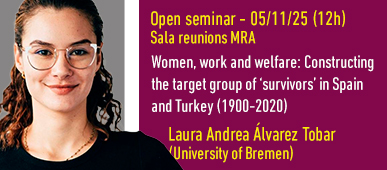
Date: 05/11/2025 a les 12h sala reunions MRA
Speaker: Laura Andrea Álvarez Tobar (University of Bremen)
Title: “Women, work and welfare: Constructing the target group of ‘survivors’ in Spain and Turkey (1900-2020)“.
Abstract:
This paper explores the historical construction of women as subjects of welfare, with an emphasis on female targets of survivors’ benefits and the conditionality associated with their relationship to paid and unpaid work. We compare the cases of Spain and Turkey, two rarely compared Southern European Welfare States, through the exploration of social policy laws (1900-2020).
By extending the analysis beyond widows to include all family members historically covered by survivors’ benefits, the study shows that conditionality reflects evolving welfare state ideas about the roles of wives, mothers, grandmothers, daughters and sisters in family and society across all life stages. We find that associating survivors’ benefits solely with old age overlooks their broader significance. We also show how the association of unpaid care work with women was framed within the nation building projects of both countries, with conditionality for spouses mostly fulfilled through women’s bodies and unpaid care work.
The paper challenges the traditional view of women’s historical framing solely as dependents, showing that they were legally constructed as both workers and caregivers since the early 1900s. Legally, the exception has not been the idea of the female worker, rather the idea of the financially dependent man. Gendered notions of vulnerability of still present in current legislation, which calls for further research into the historical institutionalization of male dependency. Finally, conditionality in survivors’ benefits has historically been designed more as a mean of sustaining moral values and gendered power relations around the division of labor within the family and society, instead of a mechanism for work activation or poverty reduction.
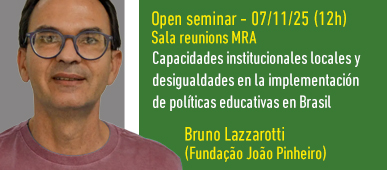
Date: 07/11/2025 a les 12h sala reunions MRA
Speaker: Bruno Lazzarotti (Fundação João Pinheiro)
Title: “Capacidades institucionales locales y desigualdades en la implementación de políticas educativas en Brasil“.
Abstract:
The seminar focuses on the debate on local institutional capacities and their relationship with inequality, a key issue for understanding why public policies are not implemented with the same effectiveness in all territories. From this perspective, the case of public basic education in Brazil will be addressed, analyzing what dimensions make up these capacities, how they can be measured, to what extent they are unevenly distributed and how they have evolved in recent years.
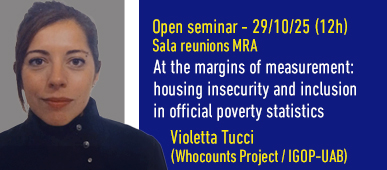
Date: 29/10/2025 a les 12h sala reunions MRA
Speaker: Violetta Tucci (IGOP – Whocounts project)
Title: “At the margins of measurement: housing insecurity and inclusion in official poverty statistics”.
Discussant: Carlos Delclós.
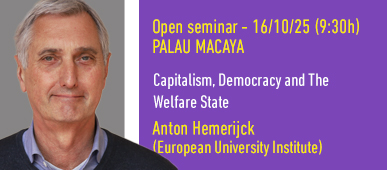
Date: 16/10/2025 a les 9:30h Palau Macaya Barcelona
Speaker: Anton Hemerijck (European University Institute)
Title: “Capitalism, Democracy and The Welfare State”.
Date: 06/10/2025 a les 12h sala reunions MRA
Speaker: Johanna Fischer (Bremen University. SOCIUM Research Centre on Inequality and Social Policy.)
Title: “Comparing long-term care leave policies in Europe“.
Discussant: Margarita León.
Abstract:
Across Europe, long-term care (LTC) for older persons has become a salient topic. As the predominant providers of LTC are (still) informal care givers – mostly female family members – they often face the issue of combining paid work and care. Care leave, which allows a temporary withdrawal from employment to engage in care work, constitutes an increasingly popular policy measure for supporting work-care conciliation. Care leave policies are very heterogenous, for instance as regards target group, duration and payment. However, there are insufficient studies on (long-term) care leave policies both in the scholarship on leave and long-term care. In the seminar talk I present my project on “long-term care leave policies in comparison” which aims to address this gap by describing and explaining LTC leave design in international-comparative perspective. The project consists of two main parts. Firstly, I aim to generate a comprehensive, original dataset on the generosity of LTC leave schemes for 27 European Union (EU) member states. In doing so, I employ a two-dimensional conceptualisation of social policy generosity, consisting of inclusiveness as the personal dimension and scope of benefit as the material dimension. Secondly, drawing on welfare state theories, I plan to investigate which explanatory factors influence the generosity design of LTC leave policies in Europe. I employ fuzzy set Qualitative Comparative Analysis for identifying which care regime institutions and socio-economic factors condition generous LTC leave. Complementing this cross-country analysis, I comparatively study LTC leave policies in two cases – Austria and Germany – with similar welfare and care arrangements to investigate in-depth how political factors and discourses have shaped the divergent care leave design in both countries. In my talk I present my project proposal and first research steps in particular on the construction of the comparative data set.
Date: 22/09/2025 a les 13h aula de seminaris DEC (Sala de juntes)
Speaker: Cecilia Josefsson (Uppsala University, Sweden)
Title: “Speaking of Women: Tracing the Evolution of Women’s Rights Norms in UN General Debate Speeches”.
Joint Seminar IGOP/DEC
Abstract:
Speaking of Women: Tracing the Evolution of Women’s Rights Norms in UN General Debate Speeches
International norms around women’s rights appear increasingly contested, even as they remain deeply embedded in global governance frameworks. This paper examines how states articulate support for—or resistance to—these norms by analyzing all United Nations General Debate (UNGD) speeches from 1946 to 2023. Drawing on nearly eight decades of annual addresses by UN member states, the study uses quantitative text analysis to track the frequency, timing, and thematic content of gender-related references. It asks: who speaks about women, girls, and gender; when; and in what terms? The findings reveal a notable increase in engagement with women’s rights since the mid-1990s, particularly after the 1995 Beijing Conference, with attention doubling after 2010. While Western liberal democracies, especially the Nordic countries, have historically acted as norm entrepreneurs, recent patterns suggest shifting centers of engagement. The study argues that global gender politics cannot be fully understood through a simple progress-versus-backlash lens. Instead, it reveals a more complex normative landscape shaped by simultaneous advancement, resistance, and strategic appropriation. By offering a longitudinal and comparative account of gender discourse in one of the UN’s most visible forums, the article contributes to broader debates on norm diffusion, international legitimacy, and the future of global gender equality.
Date: 17/09/2025 a les 12h sala de reunions de l’IGOP, MRA
Speaker: Carlos Delclós (IGOP-UAB)
Title: “Contesting Sanctuary: Urban Citizenship and Multilevel Migration Governance in Barcelona”.
Discussant: Ismael Blanco (UAB)
Abstract:
This article examines the emergence and contentious politics of urban sanctuary in Barcelona under a progressive “new municipalist” government. Through document analysis, key informant interviews, participant observation, and media and archival research conducted between 2015 and 2023, it analyses the City of Refuge programme and other local migration policies as sites of multilevel migration governance and political struggle. The article conceptualises sanctuary not as a stable policy field but as a dynamic, contentious process shaped by the interplay between legality, discourse, identity formation, and scalar negotiation. It draws on theoretical insights from scholarship on urban citizenship and multilevel governance, tracing how municipal actors and civil society mobilised symbolic and material resources to include undocumented residents and contest exclusionary national and supranational frameworks. Empirical attention is given to administrative inclusion practices, targeted social programmes, and confrontations over policy competence. The findings reveal both the transformative potential and structural limitations of municipal sanctuary initiatives, highlighting the tensions between symbolic commitments to inclusion and the constrained capacities of local governments within hierarchical systems of governance. Barcelona thus offers a paradigmatic case for understanding how cities reconfigure—and are constrained by—the scalar politics of migration governance.
Date: 3/06/2025 a les 12h Escola de l’IGOP (Pg Urrutia, 17 Barcelona)
Speaker: Adriana Rofman
Institution: (FLACSO Argentina)
“Políticas sociales en la Argentina de Milei: de la participación a la individualización”.
Discussant: Òscar Rebollo (UAB)
Abstract:
Within the context of a radical reduction in the role of the State, the current Argentine government has undertaken a neoliberal reformulation of social policies addressing social vulnerability. This reform consists of drastically reducing participatory management programs developed throughout this century in order to strengthen the policy of individual cash transfers. This budgetary, programmatic, and regulatory reconfiguration is accompanied by a narrative campaign to delegitimize territorial community organizing, a combination that dismantles a tradition of public-social actions aimed at social integration in vulnerable territories. Based on a detailed analysis of these changes, we examine their potential effects on social cohesion and on the relationship between society and public institutions.
Date: 4/06/2025 a les 12h sala de reunions de l’IGOP, MRA
Speaker: Alice Lancien
Institution: (Université Paris Nanterre)
“Habitar la inestabilidad. La gentrificación de los centros históricos desde el prisma de los jóvenes de clases populares (París-Barcelona)”.
Discussant: Carlos Delclós (UAB)
Abstract:
This presentation is based on the results of Alice Lancien’s doctoral thesis, a joint project between the Autonomous University of Barcelona and Paris Nanterre University. The thesis focuses on the urban socialization of working-class youth from the historic districts of Paris and Barcelona. It is based on an ethnographic survey conducted between February 2018 and January 2020 in the La Chapelle (Paris) and Raval (Barcelona) neighborhoods.
By challenging the socialization of working-class youth groups, generally assumed to be solely peer-based and neighborhood-based, the thesis investigates how working-class people in historic city centers have experienced gentrification and social mixing. It aligns with studies that address gentrification as a complex process, far from being a simple, linear displacement-replacement dynamic, and examines the strategies individuals develop to cope with it. This thesis sheds light on a popular youth urbanity in constant negotiation, which transforms as the city does.
Date: 21/05/2025 a les 12h sala de reunions de l’IGOP, MRA
Speaker: Alejandro Carrasco
Institution: (Pontificia Universidad Católica de Chile)
“The School Inclusion Law in Chile: Highs and lows after 10 years of implementation”.
Discussant: Adrián Zancajo (UAB).
Alejandro Carrasco Professor Facultat d’Educació (Pontificia Universidad Católica de Chile), actualment Degà, i investigador a CEPPE UC i Centre de Justícia Educacional. Sociòleg UC i PhD a la Universitat de Cambridge, UK.
Abstract:
Chile has been a paradigmatic example of organizing a market-based education system for four decades. The Inclusion Law was implemented 10 years ago with the aim of reorganizing these principles that inspire educational provision, as well as addressing the decades-long effects of these market-driven policy initiatives. The seminar provides a comprehensive review of the core components of the Inclusion Law, the justification for its incorporation, the conceptual tools for understanding it, and the results of early evaluation of its implementation. The seminar provides insight into the cultural, political, and policy difficulties in transforming education systems deeply informed and structured by neoliberal principles.

Date: 14/05/2025 a les 12h sala de reunions de l’IGOP, MRA
Speaker: Rasmus Broms
Institution: (University of Gothenburg)
“Privatization of welfare and quality outcomes: The case of residential elder care in Sweden”.
Discussant: Joaquín Rozas (UPF). El seminari s’emmarca en el projecte CARE-Spain.
Rasmus Broms és professor titular de ciència política al Departament de Ciència Política de la Universitat de Göteborg. La seva recerca se centra principalment en les institucions i la responsabilitat local.
Abstract:
The privatization of welfare services is frequently discussed, but its impact on quality is less frequently studied empirically. Drawing on a series of studies of long-term care facilities for the elderly in Sweden, we explore whether and how private provision affects quality outcomes. We find no overall difference between public and private care. However, the type of private provider matters: non-profit organizations provide better quality care compared to publicly traded corporations and private equity firms.
Date: 05/03/2025 a les 12h sala de reunions de l’IGOP, MRA
Speaker: Adrian Bua
Institution: (UAB)
“Critical democratic realism in theory and practice”.
Discussant: Yanina Welp (Albert Hirshman Centre on Democracy)
Adrian holds a PhD in Political Science from the University of East Anglia (UK). His research focuses on the intersection of democratic theory, critical political economy, and public policy. He is currently interested in participatory governance policies and the role of participation in (de)democratization and broader social change within capitalism.
Adrian joined IGOP in 2023 as a Marie Curie Fellow to research the politics of urban regime stability and change during the wave of Spanish New Municipalism (2015-2019). During his time at IGOP, he will also work on the Horizon Project INSPIRE (Intersectional Spaces of Participation: Inclusive, Resilient, Integrated) as a co-investigator, focusing on the political economy of participatory democracy.
Date: 19/02/2025 a les 12h sala de reunions de l’IGOP, MRA
Speaker: Irene Lapuerta
Institution: (Universidad Pública de Navarra)
“¿Premio o penalización por paternidad? El impacto del nacimiento de los hijos en los salarios de los hombres en España desde un enfoque interseccional”.
Discussant: Danislava Marinova (IGOP-UAB)
Irene Lapuerta és llicenciada en Ciències Polítiques i de l’Administració per la Universitat de Santiago de Compostela, Màster en Polítiques Públiques i Socials i Doctora en Ciències Polítiques i Socials per la Universitat Pompeu Fabra. Les seves línies de recerca principals se centren en l’estudi de les polítiques familiars, el mercat de treball i les desigualtats de gènere.
Actualment, exerceix com a professora de l’àrea de Treball Social i Serveis Socials del departament de Sociologia i Treball Social de la Universitat Pública de Navarra.
Abstract:
This study analyses the impact of fatherhood on earnings in Spain using data from 2005 to 2021. Although there is much research on how motherhood affects earnings, the influence of fatherhood, especially in Spain, is less explored. In some countries, fathers experience a “fatherhood premium”, attributed to gender role specialization, employer preferences for male workers and self-selection for fatherhood. This study aims to assess the impact of fatherhood on men’s earnings, focusing on wage distribution, family structure and the use of long-term parental leave (parental leave and reduced working hours for legal guardianship). Three key hypotheses are tested. First, the fatherhood premium is expected to be more pronounced among higher-paid fathers. Second, it is expected to be greater in heterosexual couples due to gender specialization. Third, we expect that the use of parental leave will penalize men’s wages due to the stigma of low work commitment of those who take it. The study uses panel data from the Continuous Sample of Working Lives (waves 2005-2022). Unconditional quantile regression on longitudinal data is used to estimate the differences in earnings between men with and without children. Fixed-effects regression techniques are used to account for self-selection to fatherhood.

Date: 11/02/2025 a les 12h sala de reunions de l’IGOP, MRA
Speaker: Paolo Funari
Institution: (Doctorand en estada)
”The Politics of Labour Market Policy in the Age of Automation: A Theoretical Framework”.
Discussant: Oscar Molina (QUIT)
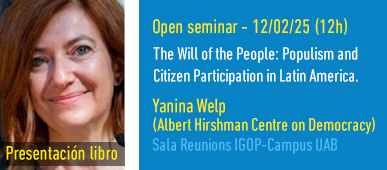
Date: 12/02/2025 a les 12h sala de reunions de l’IGOP, MRA
Speaker: Yanina Welp
Institution: (Albert Hirshman Centre on Democracy)
Presentació del llibre: ”The Will of the People: Populism and Citizen Participation in Latin America”.
Discussant: Adrian Bua (IGOP-UAB)
Yanina Welp es Doctora en Ciencias Políticas y Sociales por la Universidad Pompeu Fabra (Barcelona, España) y Licenciada en Ciencia Política y en Ciencias de la Comunicación Social, ambas por la Universidad de Buenos Aires (Argentina).
Desde 2019, es investigadora en el centro Albert Hirshman for Democracy en Ginebra. Entre 2016 y 2019 fue codirectora del Latin American Zurich Center, en la universidad de Zurich. También es cofundadora de la Red de Politólogas y miembro de los consejos del Observatorio de Reformas Políticas, el Real Instituto Elcano y el CIEPS.
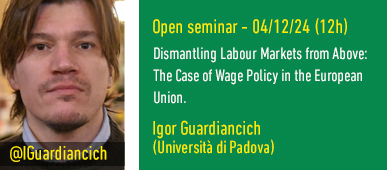
Date: 04/12/2024 a les 12h sala de reunions de l’IGOP, MRA
Speaker: Igor Guardiancich
Institution: (Università di Padova)
Title: Dismantling Labour Markets from Above: The Case of Wage Policy the European Union.
Discussant: Oscar Molina (QUIT)
Igor Guardiancich és professor adjunt al Departament de Ciència Política, Dret i Estudis Internacionals (SPGI) de la Universitat de Pàdua.
Guardiancich’s research focuses on political economy, public and social policy, European integration, the transition in Central and Eastern Europe, social dialogue and industrial relations. His work includes the monograph Pension Reforms in Central, Eastern and Southeastern Europe: From Post-Socialist Transition to the Global Financial Crisis published by Routledge in 2013, and the volume co-edited with Oscar Molina in 2017 for the ILO, Talking through the Crisis: Trends in Social Dialogue and Industrial Relations in Selected EU Countries. In addition to these books, he has published in highly regarded international peer-reviewed journals, including European Union Politics, Governance, Journal of Common Market Studies, Regulation & Governance, Socio-Economic Review, West European Politics and several others.
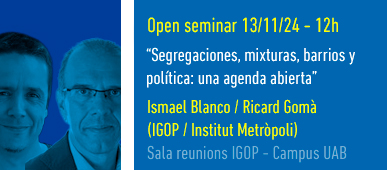
Date: 13/11/2024 a les 12h sala de reunions de l’IGOP, MRA.
Speakers: Ismael Blanco / Ricard Gomà
Institution: (IGOP / Institut Metròpoli)
“Segregaciones, mixturas, barrios y polítíca: una agenda abierta”.
Ismael Blanco es Doctor en Ciencia Política por la Universidad Autónoma de Barcelona. Director del IGOP y Catedrático del Departamento de Ciencia Política y Derecho Público de la UAB, con la acreditación de Investigación Avanzada (Catedrático) de la AQU Como investigador Ramon y Cajal ha estado vinculado al Departamento de Ciencias Políticas y Sociales de la Universidad Pompeu Fabra. Ha sido investigador Beatriu de Pinós en el Departamento de Políticas Públicas de la De Montfort University (UK), e investigador visitante en la Universidad Federal de Minas Gerais y en la Fundación Joao Pinheiro (Brasil). Ha sido coordinador del SGR Urban Governance, Commons, Internet y Social Innovation (URGOCIS), y es miembro del SGR i-GOP. Sus recientes investigaciones se centran en las dinámicas de desigualdad y segregación socioespacial en contextos metropolitanos, en el valor de la infraestructura social urbana como factor de cohesión social y territorial y en las respuestas comunitarias e institucionales locales a los retos de la desigualdad.
Ricard Gomà es profesor de Ciencia Política en la Universidad Autónoma de Barcelona (UAB). Director del Institut Metrópoli desde 2016. Investigador en el Institut de Govern i Polítiques Públiques (IGOP-UAB). Es Doctor en Ciencia Política y de la Administración (Universidad Autónoma de Barcelona 1992). También es master en Políticas Públicas (University of Strathclyde, Escocia 1989) y master en Estudios Urbanos, Regionales y Metropolitanos (Universidad Autónoma de Barcelona, 1990). Profesor Titular de Ciencia Política (UAB), desde 1993, ha sido profesor visitante en las universidades de Warwick, UK (1995) y Bath, UK (1998 y 2002). Ha impartido docencia en programas de doctorado y posgrado en universidades europeas (Reino Unido, Italia) y latinoamericanas (Argentina, Brasil, México, entre otros).
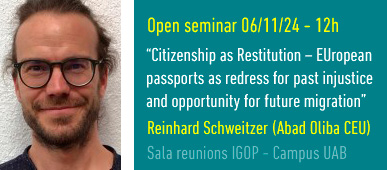
Date: 06/11/2024 a les 12h sala de reunions de l’IGOP, MRA
Speaker: Reinhard Schweitzer
Institution: (Universitat Abad Oliba CEU)
Seminari conjunt amb l’SGR Transdem
“Citizenship as Restitution – EUropean passports as redress for past injustice and opportunity for future migration”.
Discussant: Eva Ostergaard-Nielsen (UAB)
Research Professor at Universitat Abat Oliba CEU in Barcelona, also associated with the Barcelona Centre for International Affairs (CIDOB) and the Sussex Centre for Migration Research (SCMR) in Brighton, UK. Associate Editor of the Journal of Ethnic and Migration Studies. PhD in Migration Studies (2018, University of Sussex) and degrees in Political Science and Sociology (University of Innsbruck). Previously Marie Skłodowska-Curie Individual Research Fellow at the Department of Political Science of the University of Vienna (project REvolTURN). His research focusses on the politics, practices, and challenges of governing international migration across different political and administrative levels, geographical contexts, and institutional settings. From an interdisciplinary and comparative perspective, he studies legal frameworks, everyday practices of policy implementation, and ways in which migrants perceive, use, bend, or resist the rules and restrictions imposed on their mobility and “integration”.
Date: 02/10/2024 a les 12:30h sala de reunions de l’IGOP, MRA
Speaker: Gülce Özdemir
Institution: (UPF)
“Intersectional (In)visibility: experiences of irregular migrants in Barcelona”.
Article available at: https://www.tandfonline.com/doi/full/10.1080/1369183X.2023.2298351
Discussant: Daniel Edmiston (IGOP-UAB)
Özdemir holds a PhD from the Department of Political and Social Sciences at Universitat Pompeu Fabra (UPF). She studies the complex relationships between political structures, social phenomena, and marginalized communities. She has a diverse range of publications, including policy papers and peer-reviewed articles in top-tier journals such as Cities and the Journal of Ethnic and Migration Studies. Her particular focus is on the intersection of irregular migration and urban settings, and how local and national policy dynamics shape the experiences of migrants in cities. Through her work, she aims to identify strategies for creating more inclusive and just urban environments for all residents, regardless of their migration status. I hold positions as pre- and post-doctoral researchers at prestigious universities and institutions including UAB Institut Barcelona d’Estudis Internacionals, and United Nations University – World Institute for Development Economics Research.
Date: 12/09/2024 a les 13h sala de juntes Facultat CCPP, UAB
Speaker: Tijs Laenen
Institution: (KU Leuven, Belgium)
Joint Seminar with SGR DEC
“The pocket v. the poor. A survey experiment on the role of negativity bias in shaping popular support for welfare reform”
12/06/2024 a les 12:30h sala de reunions de l’IGOP, MRA
Vanessa Marx
Programa de Posgrado en Sociologia (UFRGS)
“La influencia de la internacionalización de las ciudades en la dinámica de los barrios (Floresta-Porto Alegre, Poblenou- Barcelona, Ciudad Vieja- Montevideo)”
17/04/2024 a les 12:30h sala de reunions de l’IGOP, MRA
Nicolina Kirby
(Research Institute for Sustainability, Postdam)
“Strengthening community resilience through participation – a conceptual and empirical exploration”

20/03/2024 a les 12:30h sala de reunions de l’IGOP, MRA
Pernelle Smits ( + info )
(FSA ULaval)
“Governance of interorganizational collaborations : key functions, top challenges, practical knowledge”
15/03/2024 a les 13h seminari A Facultat CCPP i Sociologia, UAB
Manuel Ángel Río Ruiz
(Universidad de Sevilla)
“Escuelas infantiles públicas y familias en el campo de la educabilidad 0-3 años en Barcelona: cambios, tensiones, interdependencias y diferencias”
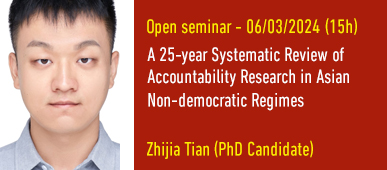
06/03/2024 a les 15h seminari A Facultat CCPP i Sociologia, UAB
Zhija Tian ( + info )
(investigador pre-doctoral IGOP-UAB)
Seminari del programa de doctorat PPIR
“A 25-year Systematic Review of Accountability Research in Asian Non-democratic Regime”.
Discussant: Núria Font

14/02/2024 a les 12:30h sala de reunions de l’IGOP, MRA
Pieter Vanhuysse
(PhD, LSE)
“Do low-fertility European societies tax their own reproduction?”

01/02/2024 a les 13h sala de reunions de l’IGOP, MRA
Pia Schrober
(University of Tübingen)
“Parental leave and day-care policy, take-up consequences and changing normative beliefs: Evidence from two survey experiments”

23/01/2024 a les 12h sala de reunions de l’IGOP, MRA
Manuel Alvariño ( + info ) i Llorenç Soler (+ info)
(investigador pre-doctoral al European University Institute / Doctorand IGOP-UAB)
“Politics of Welfare State”
“Framing the political debate: how party politics (des)politicizes and explains dissimilar minimum income reforms in Southern Europe.”
Llorenç Soler
Discussant: Leire Rincón
“The Mediterranean pioneer: explaining Spain gender-targeted leaves through feminist strategies in favourable political and institutional conditions”
Manuel Alvariño
Discussant: Dani Marinova, IGOP-UAB
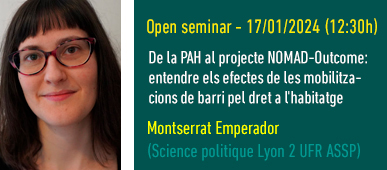
17/01/24 a les 12:30h – sala de reunions de l’IGOP, MRA
Montserrat Emperador ( + info )
(Maîtresse de conférences en Science politique Lyon 2 UFR ASSP)
“De la PAH al projecte NOMAD-Outcome: entendre els efectes de les mobilitzacions de barri pel dret a l’habitatge”.
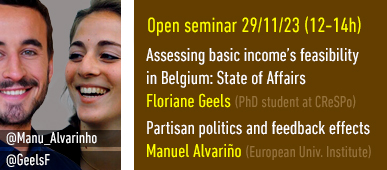
29/11/2023 a les 12h sala de reunions de l’IGOP, MRA
Floriane Geels
(Phd Student at CReSPo, UCLouvain Saint-Louis Bruxelles)
“Assessing basic income’s feasibility in Belgium: State of affairs.”
Discussant: Llorenç Soler
29/11/2023 a les 13h sala de reunions de l’IGOP, MRA
Manuel Alvariño ( + info )
(investigador pre-doctoral al European University Institute)
“Partisan politics and feedback effects: comparing defamilialization by center-right parties across six familistic countries”
(seminari en anglès)
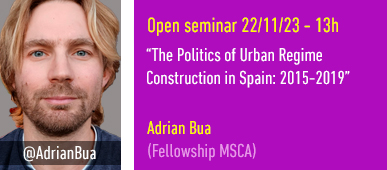
22/11/2023 a les 13h sala de reunions de l’IGOP, MRA
Adrian Bua
(fellowship MSCA)
“The Politics of Urban Regime Construction in Spain: 2015-2019”
(seminari en anglès)

31/10/2023 a les 12:30h sala de reunions de l’IGOP, MRA
Marianne Maeckelbergh ( + info )
(Ghent University and Leiden University)
Marta Ill Raga
(Politòloga UPF i investigadora predoctoral a Ghent University)
“Property and Democratic Citizenship”
(workshop en anglès)
Abstract:
Project funded by the European Research Council which uses conflicts over property to explore how various property regimes impact people’s experiences of citizenship across five democratic countries (Greece, the Netherlands, Spain, the UK, and the US).
Discussant: Carlos Delclós, IGOP-UAB, professor Serra Hunter al departament de Sociologia de la UAB.

27/10/2023 a les 09:45h sala de reunions de l’IGOP, MRA
Workshop projecte ECIU “RN4EUHEALTH”
“Solidarity in Health at the European level. Towards a research network on the European Health Union”
(workshop en anglès)

28/09/2023 a les 12:00h sala de reunions de l’IGOP, MRA
Ralph Horne
(Associate Deputy Vice-Chancellor, Research and Innovation RMIT University) “Recycling in urban apartments: how can the waste burden can be more justly distributed?” (seminari en anglès)
Abstract:
Apartments are of particular interest in zero waste debates. They are associated with lower recycling rates than other housing typologies. Plastic bag levy policies have been found to have a significant effect among owner-occupiers of high-rise apartments with higher socio-economic status, but a minimal effect among lower socio-economic households and renters. This points to the unequal effects of waste reduction measures across housing types, class, and tenure types.
Paying heed to rhythms of urban waste can provide insights into how the waste burden can be more justly distributed. In Australia, as in other owner-occupier, suburban based societies, housing is an essential locus for the domestic waste regime, and apartments are anomalies that disrupt it. Rather than assuming that the aforementioned lower recycling rates are a product of household behaviour, we present empirical research that reveals dynamics at play that make apartments incompatible with normalised waste regimes. Spatio-temporal knowledge of waste and apartment living is embodied and experienced, doing places and doing times form the rhythms of waste. Understanding and addressing these is thus a key to addressing uneven urban waste practices.

19/04/23 a les 12:30h sala de reunions de l’IGOP, MRA
Lara Maestripieri,
(IGOP-UAB)
“The VulnYouth project: how labour precariousness influence mental health?”.
Discussant: Andrea Bellini (Università La Sapienza di Roma)
(seminari en anglès)

03/05/23 a les 12:30h sala de reunions de l’IGOP, MRA
Stephan Köppe,
(University College Dublin, School of Social Policy, Social Work and Social Justice)
“Paternity Leave – Latte Papa or NASCAR Dads?”.
(seminari en anglès)
Resum. Tot i que el permís de paternitat és obligatori a la UE des de l’estiu del 2022 en virtut de la Directiva sobre la conciliació de la vida laboral i familiar, poc se sap sobre els nous pares que s’acullen a aquest breu permís. Mentre que la majoria de les investigacions s’han centrat en el permís parental compartit, normalment més llarg, i la desigualtat de gènere en el seu ús, el permís de paternitat ha rebut menys atenció. La xerrada explora si els pares que s’acullen al permís segueixen el model idealitzat del pare suec Latte amb estil i un impuls progressista cap a la igualtat de gènere. Els tradicionals pares NASCAR de classe treballadora blanca també estan adoptant nous rols de cura? Per respondre aquestes preguntes, la feina té dues vessants:
En primer lloc, una revisió bibliogràfica estructurada de 118 estudis publicats entre el 1980 i el 2022 traça l’estat actual de la investigació sobre la prestació per paternitat. Al mateix temps que es destaquen les principals conclusions sobre la política, l’adopció i els resultats, també se subratllen els biaixos i les llacunes de coneixement.
En segon lloc, es presenten conclusions noves sobre els pares irlandesos que s’acullen al permís de paternitat. Com un dels darrers països de la UE, Irlanda va adoptar un permís de dues setmanes el 2016. Es proporciona una visió global de l’acceptació mitjançant el mesurament de quatre taxes d’acceptació (bruta, ajustada, elegibilitat, gènere). Les desigualtats ocupacionals i d’edat en l’acceptació es revelen i es discuteixen en el context dels criteris d’elegibilitat i la prestació a preu fet. Aquestes xifres agregades es complementen amb les microdades de l’Enquesta de Població Activa per revelar altres factors sociodemogràfics i professionals de l’acceptació. S’identifiquen dos mons de paternitat: Els Latte Papa estan més ben formats, perceben ingressos més elevats i tenen millor accés a les prestacions professionals, mentre que els seus homòlegs de classe treballadora no es poden permetre el permís i perden l’oportunitat d’assumir noves funcions paternes.

17/05/23 a les 12:30h sala de reunions de l’IGOP, MRA
Peter Starke,
(Southern Denmark University)
“La relación entre cambio climático, estado de bienestar y política social”.
(seminari en anglès)
Resum: L’augment de la inseguretat és un sentiment compartit per molts, i alguns grups mostren més vulnerabilitat a les crisis que altres. Aquest treball investiga com es distribueix la inseguretat subjectiva i si els estats de benestar poden mitigar aquesta discrepància. La investigació utilitza models multinivell amb dades transnacionals d’aproximadament 19.000 individus de 20 democràcies avançades de l’OCDE. Els nostres resultats suggereixen que malgrat la capacitat de l’Estat del benestar per reduir la inseguretat general, no aconsegueix reduir significativament la bretxa de seguretat entre els grups d’ingressos. Aquesta conclusió és reforçada per les dades de l’enquesta nacional de Dinamarca, que indiquen tant un augment de la inseguretat com un increment de la bretxa de seguretat.
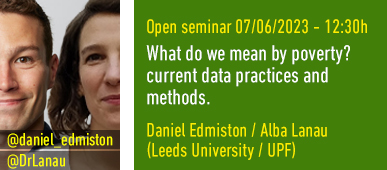
07/06/23 a les 12:30h sala de reunions de l’IGOP, MRA
Alba Lanau and Daniel Edmiston,
(Universitat Pompeu Fabra / Leeds University)
“What do we mean by poverty? current data practices and methods. A discussion from research the UK and Barcelona ”.
(seminari en anglès).
Daniel Edmiston és professor associat de sociologia i política social a la Universitat de Leeds. S’unirà a la Universitat Autònoma de Barcelona al novembre per iniciar un nou projecte ERC sobre el mesurament de la pobresa a Europa.
Alba Lanau, professora i Investigadora Ramon i Cajal a la Universitat Pompeu Fabra. Doctora en política social i especialista en pobresa multidimensional i benestar infantil. És editora associada del Journal of Poverty and Social Justice.

19/06/23 a les 12:30h sala de reunions de l’IGOP, MRA
Gabriele D’Adda,
(University of Catania)
“Las respuestas de los movimientos sociales y de las instituciones locales a las consecuencias emocionales de la precariedad habitativa. Perspectivas desde Bolonia y Barcelona”.
Doctor en Filosofia per la Kent Law School, Doctorant en Ciències Polítiques per la Università degli studi di Catania i investigador visitant a l’Institut de Govern i Polítiques Públiques (IGOP) de la Universitat Autònoma de Barcelona (UAB). Actualment investiga com els moviments socials a Barcelona i Bolonya van respondre a les conseqüències de la pandèmia de COVID19 a l’habitatge (re)creant i adaptant les seves estratègies i repertoris d’accions.

28/06/23 a les 12:30h sala de reunions de l’IGOP, MRA
Paula Amaya,
(Universidad Nacional Arturo Jauretche – Argentina)
“Capacidades institucionales, gobiernos locales y transformación social”.
Doctora en Polítiques Públiques i Transformació Social, Universitat Autònoma de Barcelona. Màster en Govern i Desenvolupament (UNSAM). Llicenciada en Ciències de l´Educació, UNLP. Directora del Programa de Govern, Polítiques Públiques i transformació social de la Universitat Nacional Arturo Jauretche. Docent i investigadora de la Universitat Nacional Arturo Jauretche. Docent en la Diplomatura en Gestió i Control de Polítiques Públiques a Flacso Argentina.