
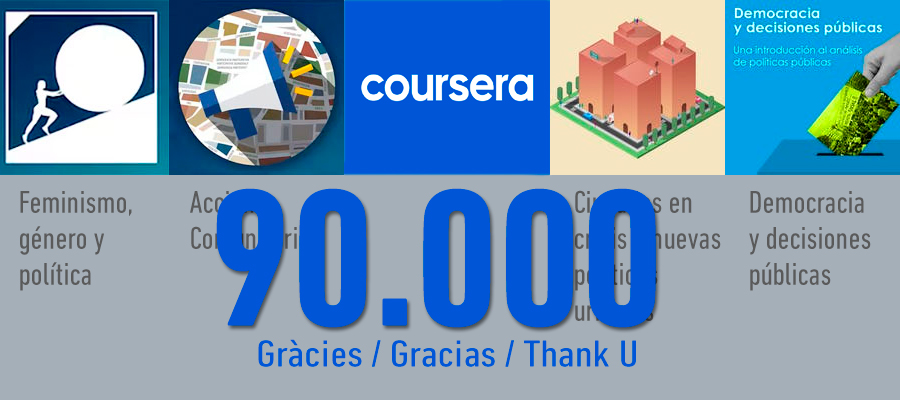
Amid the rapid expansion of digital education, our online courses have recently surpassed 90,000 enrollments, a milestone that consolidates our position as a national and European benchmark in massive, open and accessible training in public policy. This figure reflects the trust that thousands of students and professionals place in the quality, scope and relevance of the content we offer.
A collective achievement
The IGOP’s commitment to open and universally accessible education —aligned with the UAB’s strategy— has taken shape through its MOOC courses (massive open online courses), available on the Coursera platform since 2013.
With a total of 90,259 enrollments, this number highlights the programme’s ability to reach a wide audience: from university students, unemployed or active professionals, to people interested in reskilling or acquiring new competencies.
Our courses within your reach
The current courses available on the platform are:
-
Democracy and Public Decision-Making. Introduction to Public Policy Analysis – a key course for understanding how public policies are defined and implemented.
-
Cities in Crisis and New Urban Policies – designed to analyse contemporary urban challenges amid social and technological transformation.
-
Community Action Approaches to social transformation – an introduction to community work and social policies.
-
Feminism, Gender and Politics – a space for reflection and debate on gender, equality and power in contemporary society.
Our courses cover a wide range of topics, including public policy, urban studies, community action, gender, social transformation, and more.
Gratitude and responsibility
We would like to express our sincere gratitude to all the people who have chosen to learn with us: your trust motivates us to continue improving and expanding our offering.
This success also brings responsibility: we will continue working to ensure that IGOP-UAB’s online training remains high-quality, up-to-date, accessible and relevant to the social, political and cultural realities of our environment.