

We are launching the European project INTEGRED to transform governance and the use of evidence in educational policies.
- Coordinated by the Autonomous University of Barcelona (UAB), the project brings together 13 European institutions to develop a new integrated evaluation framework.
- The initiative will evaluate 7 preventive educational policies across 6 countries (Finland, the Netherlands, Poland, Hungary, Austria, and Spain) and provide university-level training to public policymakers and educators.
BARCELONA | October 13, 2026
On October 8, the European research project INTEGRED (An Integrative Approach to the Production, Use and Governance of Evidence in European Education) was officially launched—a 42-month initiative funded by the European Commission’s Horizon Europe program.

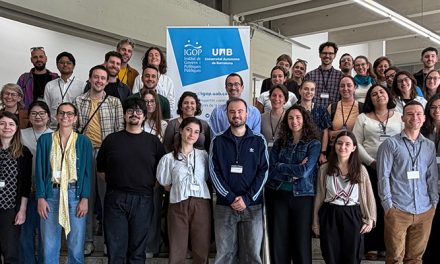
The kick-off meeting, held in Barcelona on October 8th and 9th, was attended by Rector Javier Lafuente, who highlighted the importance of collaborative work between institutions, as well as the capacity and transformative potential of university-based research. Over the course of the two days, participants had the opportunity to share knowledge, identify methodological challenges, and clarify collaboration mechanisms for the project’s development.
The project
The project —coordinated by the Autonomous University of Barcelona (UAB) and led by Professor Antoni Verger—addresses the urgent need to overcome the current fragmentation in the evaluation of educational policies. While quantitative methods provide data on the direct impact of a measure, they often fail to capture the complexity of school contexts; conversely, while qualitative methods analyze context, they struggle to establish causality. To tackle this challenge, INTEGRED will develop the Integrative Evaluation Framework (IEF)—an innovative model that combines evaluation approaches based on different logics of causal inference (specifically counterfactual and theory-based methods)—and promotes the co-creation of knowledge among researchers, educational policymakers, and teaching staff.
“INTEGRED does not seek to offer abstract evaluation tools, but rather to build a model of sound evidence governance that integrates into the routines of educational administrations and improves equity in the classroom,” highlights the UAB coordination team.
During its development, the IEF framework will be tested through 7 pilot studies in 6 European countries, addressing challenges such as transitions between educational stages (in Finland, the Netherlands, and Poland) and the reduction of learning gaps through tutoring programs, inclusive teaching, and school assessment (in Spain, Hungary, and Austria). Furthermore, the project includes an institutional capacity-building dimension, which will offer 5-ECTS university micro-credentials at the UAB and the University of Oslo, as well as an open-access interactive digital platform to facilitate the practical application of the assessment framework across various European educational systems.
About the INTEGRED Consortium
The INTEGRED consortium is led by the Universitat Autònoma de Barcelona (UAB) and includes 12 high-caliber partners and associated entities: Università degli Studi di Milano, ELTE KRTK, Stichting VU Amsterdam, the University of Oslo, Tampere University, IE Business School, the Educational Research Institute (IBE), Stichting Radboud Universiteit, the Education Endowment Foundation (EEF), the UniCredit Foundation (UCF), the European Educational Research Association (EERA), and the Catalan Institute for the Evaluation of Public Policies (Ivàlua).

For further information: jaume.badosa@uab.cat